Level Up Your African Fabric Quilting Patterns This Year
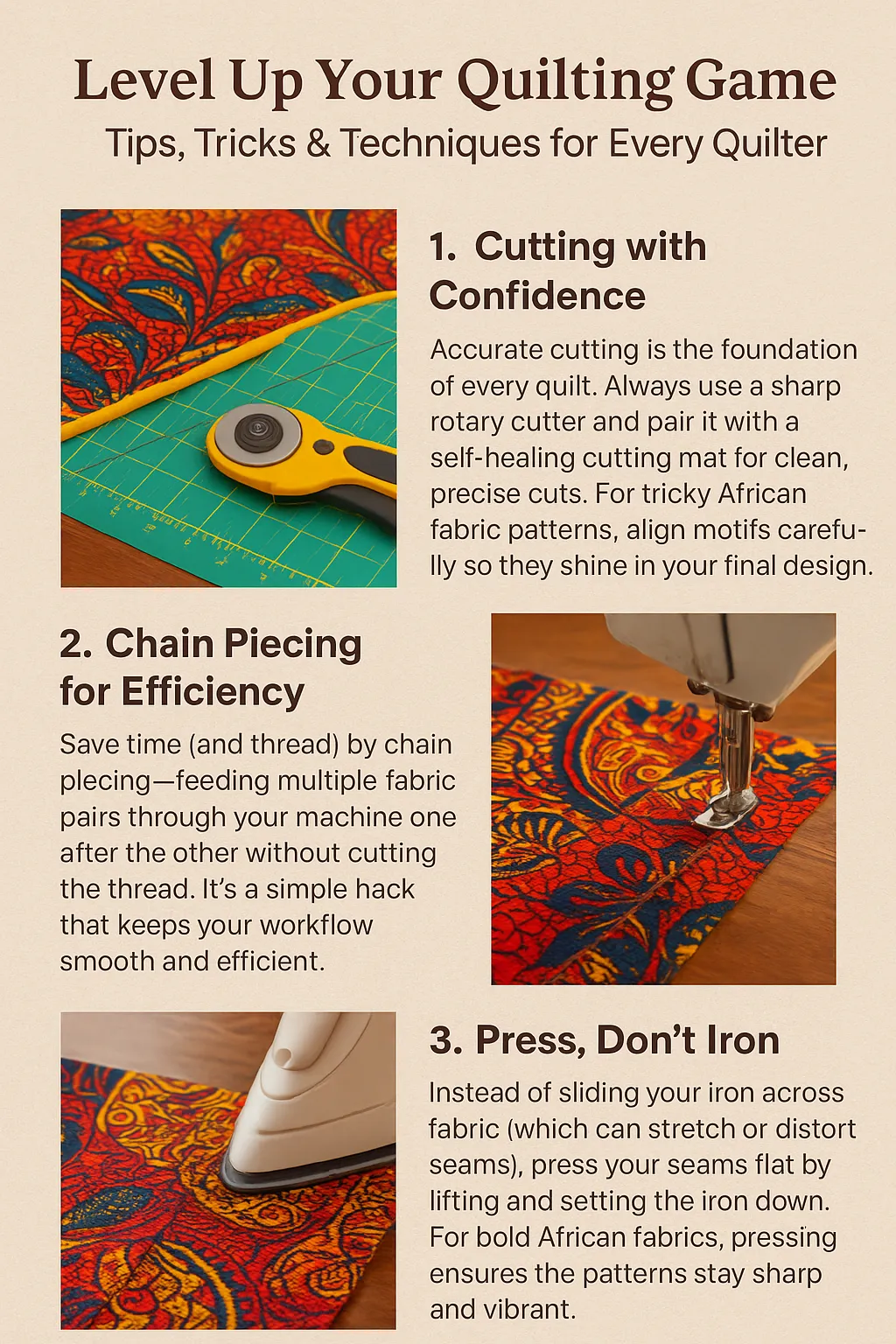
Level Up Your Quilting Game: Tips, Tricks & Techniques for Every Quilter

African fabric quilting patterns are a remarkable teacher — and the more demanding ones will push you further than you think you can go.
There is a particular kind of quilter I recognise immediately. She has been making quilts for a few years. She is competent — her points match, her seams are consistent, she understands colour well enough to put together a top that works. But something is nagging at her. She is making quilts. She wants to make better quilts.
If that is you, this post is for you.
Growing as a quilter with African fabrics is not simply about learning more patterns. It is about developing a deeper relationship with the cloth itself — understanding how bold print behaves differently from solid fabric, how to let the pattern in the Ankara do some of the design work, when to suppress a print and when to let it speak loudly. These are skills that take time and intention.

Here is where to focus.
Understand value before you reach for colour
This is the single most common gap I see in quilters who are ready to grow. They are making decisions about African fabric based on colour — which prints they love, which combinations are beautiful — without understanding value.
Value is the lightness or darkness of a fabric, independent of its colour. A deep indigo Adire and a forest green Ankara might look very different in colour but sit at exactly the same value. Put them next to each other in a block and they will muddy each other — the pattern will disappear.
The test is simple: photograph your fabrics in black and white. With colour removed, value becomes visible immediately. A quilt top that looked vibrant in full colour will reveal its structure — or its lack of one — in greyscale.
Start reading your African fabric quilting patterns through the lens of value, not just colour, and your work will change noticeably.

Move from copying to adapting
Following a pattern is how you learn the mechanics of a block. Adapting a pattern is how you learn to think like a quilter.
Take a pattern you know well — one you have made before — and change one decision intentionally. Not randomly. Intentionally. Scale a block up by 50%. Use three fabrics where the pattern calls for two. Flip a directional print in alternate blocks so the pattern fights itself in an interesting way.
African fabric quilting patterns reward this kind of experimentation more than plain cotton patterns do, because the fabrics themselves are so assertive. When you deliberately put a large-scale Ankara print in a small block, you are making a decision about what part of the print to show. That is design thinking. That is the skill that separates a quilter who follows patterns from one who creates with them.

Press towards precision — but understand why
Precise piecing matters more with African wax print than with most other fabrics, for a specific reason: the boldness of the print makes misalignment visible in a way that a subtle calico would hide.
If your points are not quite meeting, a low-contrast fabric will forgive you. A high-contrast Ankara will not. This is not a reason to avoid African prints — it is a reason to slow down and get the piecing right. The reward is a quilt that looks intentional all the way through.
Work on one technique at a time. Half-square triangles with consistent seam allowances. Flying geese with sharp points. Four-patch blocks that align perfectly at the centre seam. Drill the mechanics until they are reliable, then apply them to the complex African fabric quilting patterns that are waiting for you.

Add cultural context to your design decisions
This is the piece that most quilting instruction skips entirely — and it is one of the things that makes Quilt Africa different.
When you understand what Adinkra symbols mean, you start to make different decisions about how to use Adinkra-printed fabric. When you know the story behind a specific Ankara pattern — what community produced it, what occasion it was traditionally worn for — you bring that knowledge into the design. The quilt becomes something more than technically accomplished. It becomes meaningful.
This is not about becoming an academic. It is about quilting with awareness. The more you know about the cloth, the more intentional your quilting becomes. And intentional quilting, in my experience, is always better quilting.

Where to go from here
If you want structured guidance on African fabric quilting patterns with cultural context built in, Connecting the Dots is where I would send you first. Twelve blocks, each rooted in an African pattern tradition, each taught with the story behind the fabric. It is the foundation I wish every quilter who comes to Quilt Africa started with.
Ready to build a real foundation in African fabric quilting patterns — with the cultural story behind every block?
Start with Connecting the Dots — $25 →https://quiltafricafabrics.com/product-details/product/connecting-the-dots
Or if you want to take your practice further with a full year of guided making alongside a community of quilters who love African fabric the way you do:
Join the Block of the Month →https://bom.quiltafricafabrics.com/2026-bom-home
Download the Free Guide: Before You Cut - 6 Things Every Quilter Needs To Know About Quilting With African Wax Prints https://quiltafricafabrics.com/before-you-cut-african-fabrics


